

A plaid skirt gets read before it gets examined. Somewhere in the first second, well before anyone registers the length or the waistband or the quality of the cloth, the check has been sorted into one of two categories: uniform, or tailoring.
Most disappointing plaid skirts are garments that landed in the first category when their owner had intended the second. And that sorting has very little to do with the shape of the skirt. It happens at the level of the pattern, and it turns on two things shoppers usually treat as afterthoughts.
The checks carry different memories
"Plaid" does a great deal of work in retail copy and almost none in description. Several distinct patterns sit underneath the word, each arriving with its own history attached.
Tartan is the one with institutional memory: clan, regiment, school, and then punk's deliberate desecration of all three. At skirt scale it is the most legible check on the market, which is exactly why it reads as costume so readily, particularly in the red-and-green colourways carrying the heaviest historical freight.
Houndstooth comes out of tailoring rather than uniform. The broken check dissolves into texture at any distance beyond a few feet, so it behaves more like a woven cloth than a pattern, and it ages upward rather than down.
Windowpane is the most restrained of them: a wide grid of thin lines over a plain ground, lifted straight from suiting. It looks expensive more reliably than anything else here, and it does nothing whatsoever for anyone hoping a skirt might be playful.
Gingham sits outside the group, a two-colour even check with a domestic, summer register. It rarely reads as uniform. It also rarely reads as autumn.
Madras, lightweight and irregularly coloured, belongs to hot weather and collapses the moment it is asked to look serious.
Which narrows things usefully. If the intention is a skirt that behaves like a wardrobe piece rather than a reference, the field is houndstooth, windowpane, or a tartan whose colours have had the signalling drained out of them.
The ground colour settles it
This is the part that gets skipped, and it decides more than the weave does.
A check on a red or bottle-green ground announces the pattern first and the garment second. Put the same grid on brown, coffee or khaki and it reads, at three paces, as a textured neutral. The check only declares itself close up, which is precisely how a skirt meant for a Tuesday should behave.
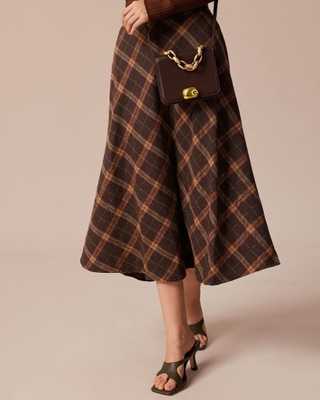
It is an unfashionable observation, because a brown check has none of the immediate charisma of a red tartan. It is also why the brown version is the one that stays in a wardrobe. It sits against camel, cream, charcoal, navy and black without negotiation, and it does not date the way a specific tartan colourway does.
Assortments built on that premise are rarer than they should be. Most plaid skirt edits run on red tartan with a black-and-white option for contrast. The RIHOAS plaid skirt edit is led by brown, coffee and khaki, with blue, pink and red as the secondary range rather than the anchor, and no black-and-white check at all. Read that as a gap or as a point of view depending on what you came for. What it means practically is that the neutral-ground version is the default there rather than the exception, across a range running roughly $25 to $47 at full price.
Length is a question about the waistband
The mini-versus-midi conversation is usually framed around how old you are or how much leg you want on display, which is tiresome and also wrong. On a checked skirt it is a structural question, because the waistband treatment changes what the pattern does.
An elastic waist gathers cloth at the top, and gathering distorts a grid. The check bends where the fabric bunches, the verticals stop being vertical, and the skirt reads softer and less deliberate. That is forgiving to fit and genuinely easy to wear, and it suits an A-line midi where the eye follows the flare rather than the grid.
A zip on a natural waist does the reverse. The grid stays square across the front, pattern matching at the side seams becomes visible, and the skirt reads as a constructed garment. It also has no give at all. RIHOAS's Brown Plaid Natural Waisted Straight Mini Skirt, a polyester and wool blend, fully lined, with a zip closure, is the clean illustration: everything making it look tailored is the same thing making it unforgiving.
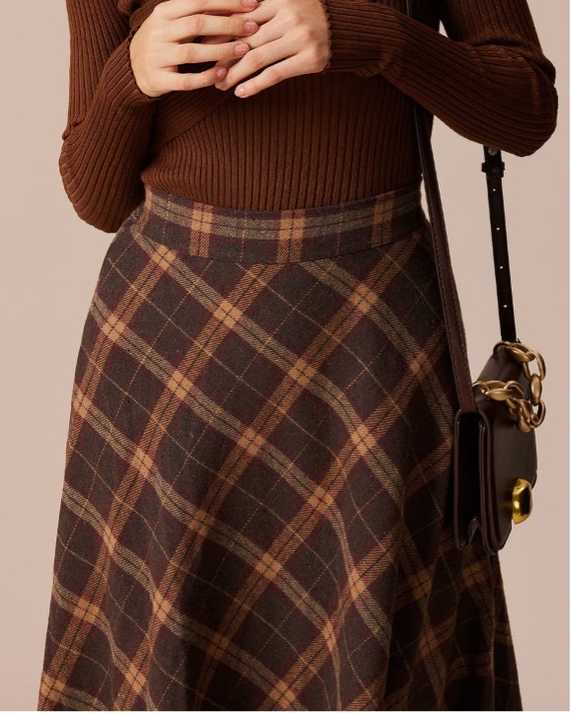
So the rule has nothing to do with hemline. Want the check to stay aligned? Take the zip and the natural waist, and size by your true waist rather than your usual dress size. Would rather not think about the waistband at all? Take the elastic and accept a softer grid. Choosing elastic and then being annoyed that the pattern looks casual is choosing both things at once.
Sizing on an elasticated skirt has one trap worth naming. RIHOAS publishes the waist range per size on that brown A-line: S covers 67–70 cm, M covers 73–76 cm. Anyone measuring 71 or 72 cm falls in the gap between them. On an elastic waist, go down and let it stretch. On a zip, go up, because 2 cm of woven fabric does not appear from anywhere.
The same size chart puts the skirt length at 83 cm in XS and 88.5 cm in XL, on a model standing 174 cm. Do that arithmetic against your own height before you assume midi means mid-calf. Under about 165 cm, it will not.
What the cloth does in October
At the accessible end of the market plaid arrives in four broad constructions, and they stop being interchangeable the moment the temperature drops.
Woven cotton holds a crisp, flat check and takes a crease, which reads clean and faintly preppy, and which will feel thin in November. Tweed adds surface irregularity, softening the check and, usefully, disguising the fact that the pattern is not perfectly matched at every seam. A wool blend holds its shape in cold and hangs with more weight, so an A-line keeps its line instead of collapsing against tights. A heavier polyester weave sits between the two and takes colour more vividly, which matters if the colourway is the point.
Lining is the detail most often left off a listing and the one most worth chasing down. An unlined check skirt over opaque tights will ride and cling. A lined one will not. It is a more consequential specification than fibre content and it costs nothing to check.
Stripping the uniform out
Once the skirt is right, very little styling is required, and most of what circulates as plaid skirt advice quietly reinstates the problem it claims to solve. A white shirt tucked into a pleated tartan mini with loafers is not a styling idea. It is the uniform, reassembled from parts.
The reliable move is to break the top half out of the same register entirely: knitwear with visible texture, a leather jacket, a soft tailored blazer in a colour that has nothing to do with the check. Anything reading as adult clothing rather than as the other half of a set. Hosiery follows the same logic. Opaque and dark, not sheer, since sheer tights under a check skirt are the shortest available route back to the schoolyard.
Though it is worth saying who this does not apply to. If the reference is the uniform, whether that is the Clueless yellow tartan, the punk kilt or the dark academia pleat, then none of the above matters and a red tartan pleated mini is the correct purchase. That is a legitimate thing to want. The mistake most people make is arriving there by accident, having believed they were buying a neutral.
Sponsored Post