
By Mark Benjamin
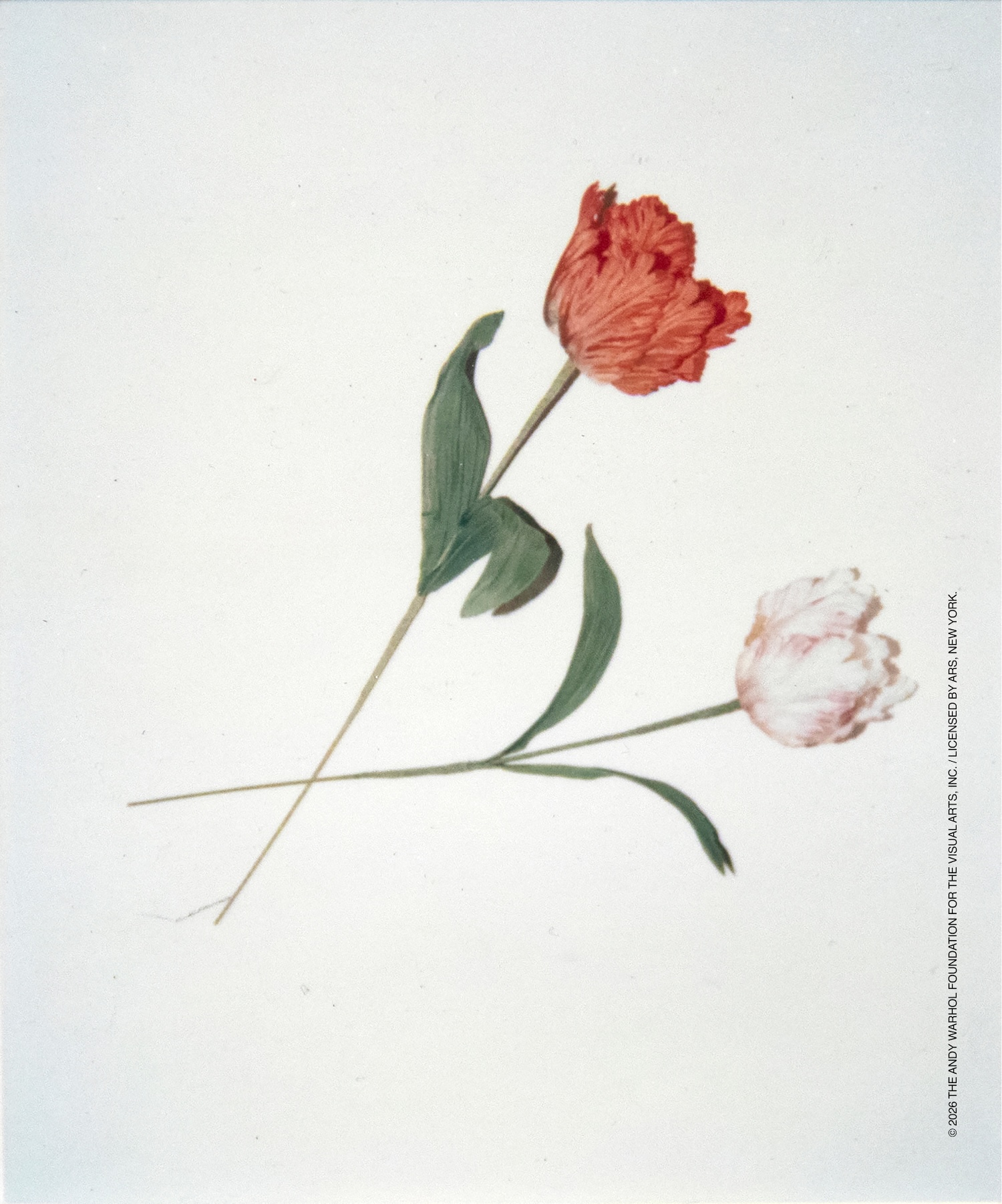
On view from April 23, Saint Laurent Rive Droite presents Banal Objects, a series of photographs by Andy Warhol that returns to the most enduring question of his practice: how is the ordinary indispensable to visual culture?
From the Big Shot Polaroid that informed his silkscreen paintings to the handheld 35mm camera he used while shaping the celebrity-driven universe of Interview, Warhol lived with a camera as an extension of his perception. Produced in the late 1970s, the Banal Objects series belongs to this lifelong visual discipline, extending an obsession already present in early 1960s films such as Sleep and Kiss, where duration and repetition rendered banality visible.
Long before celebrity portraits and mass‑produced icons crystallized his public image, Warhol understood the image as commodity. His early career as a commercial illustrator, producing shoe drawings for department store advertisements, trained his eye on surfaces designed for circulation. His first exhibition of Campbell’s Soup Cans (1962) in Los Angeles examined the collapse between object and image, alongside the diminishing presence of the artist’s hand. This retreat of gesture would later be formalized through mechanical reproduction and the establishment of the Factory.
Banal Objects occupies a space within this development. Similar to the aforementioned films, these photographs eschew spectacle and glamour, presenting instead a sustained attention to common objects as visual facts. Here, Warhol becomes a disciplined observer, advancing a radical approach to representation in which meaning is deferred through repetition and recognition: Pop Art.
A simple banana offers a familiar passage of the banal through Warhol’s logic. First appearing as a photograph translated into a screenprint in 1966, the image was later adapted as the cover for The Velvet Underground and Nico, where it entered popular culture as a graphic emblem rather than a singular artwork. Decades afterward, the motif resurfaced in Warhol’s late photographic practice through his Polaroids of everyday objects, before reappearing once more in contemporary art through Maurizio Cattelan’s act of taping a banana to a gallery wall. What persists across these gestures is not provocation, but Warhol’s foundational insight that value is produced through context, circulation, and collective fixation rather than solely artistic transformation.
The significance of Banal Objects lies in its restraint. The series invites a clear articulation of Warhol’s way of seeing, unencumbered by performance or myth. It promises to offer a rare view behind the highly mediated surface that came to define him publicly, revealing instead an artist attentive to the structures that preside over images and their dissemination.
Presented at Saint Laurent Rive Droite in Paris, the exhibition can be read as an introspective study of the ordinary and a meditation on the imagery of a consumer society. All exhibited works will be available for sale, and the exhibition will later travel to additional Saint Laurent Rive Droite locations.
Featured image courtesy: © 2026 The Andy Warhol Foundation for the Visual Arts, Inc. / Licensed by ARS, New York. Andy Warhol, Banal Objects, Saint Laurent Rive Droite Paris, April 23 – July 15, 2026.