

By Jesse Scott
“Italian by blood, Egyptian by birth, and French by destiny.” Through the eyes of Stephane Rolland, that is the story of Dalida, the legendary singer who made an indelible impact on multiple generations and nations before her tragic suicide in 1987. Over 40 years later, her legacy not only remains but continues to grow. After all, her musings on desire, death, and the meanings of life and love, expressed with an almost “existential intensity,” possess a particular universality that resonates more than ever during an era in which the arts are too often ruled by consumption rather than reflection. Stephane Rolland is acutely aware of this paradigm. And on day two of Haute Couture Week, in Paris’s legendary 123-year-old Olympia Theatre, he revived Dalida’s magic for a new generation with a tour de force 33-look show set to a live orchestra and a performance by legendary Tunisian singer Oumaima Taleb. “Through this collection, I am not hoping to recreate an era,” Rolland said. “I am hoping to recover a feeling.’
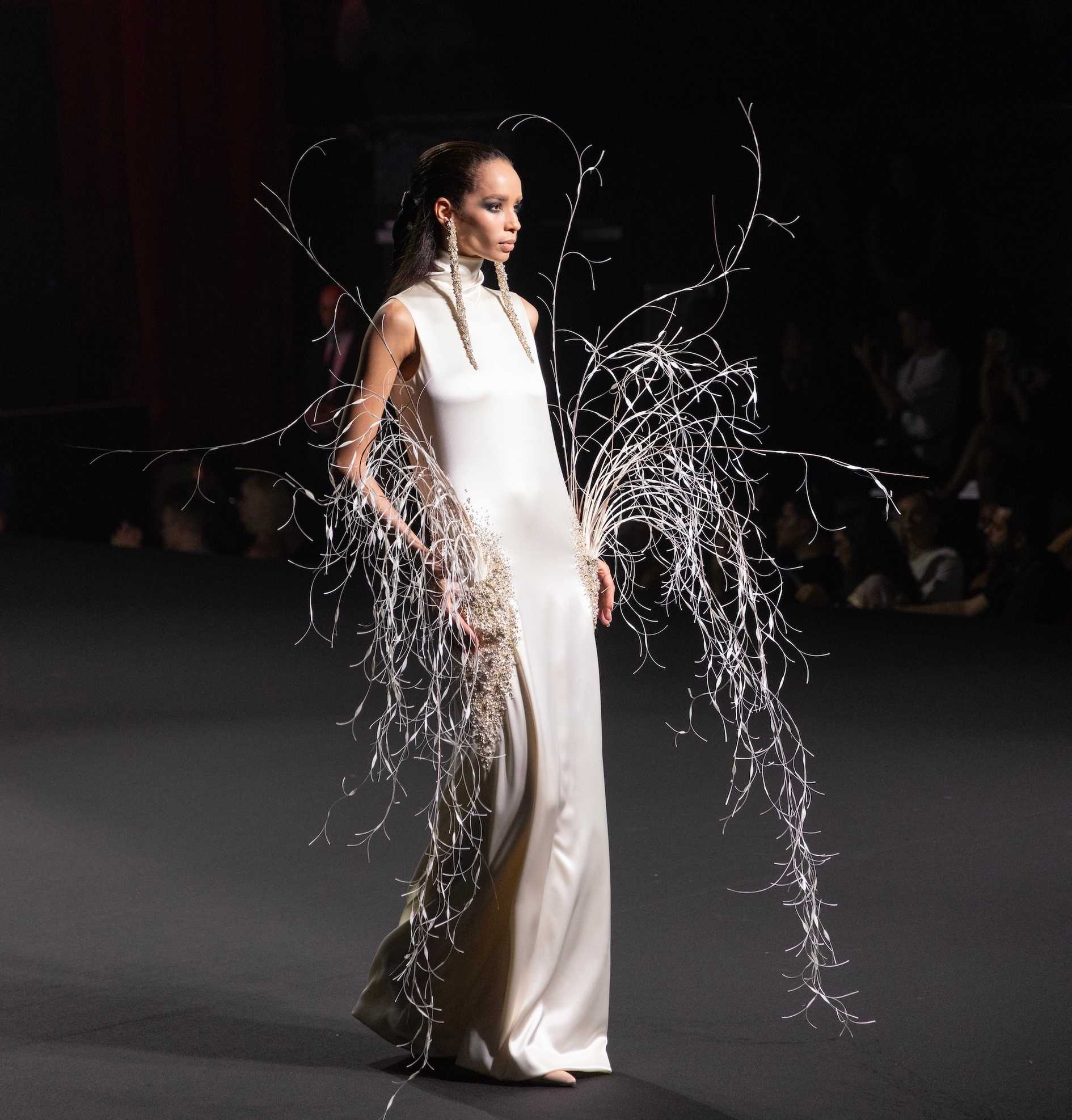
Rolland Remains the King of Fashion as Theater
Of all designers, Rolland is the best at demonstrating that fashion can be art, architecture, music, ballet, and theatre expressed through one sartorial medium. He is the king of grand spectacles on the Couture Week calendar. That said, he has never created a spectacle for the sake of creating a spectacle. Rather, each show is a passionately curated expression of a particular vision that is near and dear to his heart. This season, that vision combined the Occident and Orient - both musically and sartorially - in a way that mirrored Dalida’s own deeply international life. Echoes of both Cairo and Italy resonated throughout the theater, itself possessed of a French savoir faire that informed the entire performance.
As expected, a star-studded celebrity cast filled the Olympia’s red velvet seats. Heart Evangelista, Simona Jakstaite, Richard Orlinski, and Fan Bingbing were among those who drew a media frenzy as fans lined the pavement outside the venue. Yet the attention quickly shifted to the clothes themselves. As the opening notes of timeless 1974 song Avec les Temps filled the Olympia, a model in an elegant trouser jumpsuit in silk crêpe and white organza appeared on stage. The flowing silhouette, anchored by a striking talisman necklace, epitomized a philosophy that Rolland says is at the heart of his work: “creating garments that reveal the individual rather than erase them.” It illustrated the power of restraint: at once, noble, melancholic and brave.
White, in a wide variety of silhouettes, textures, and volumes, dominated the show. Favorite ensembles included Look 27, with its sharply cut bodice and ruffled skirt, Look 28, perhaps the most architectural dress, and Look 12, with layered petals that extended like a blooming orchid. Dark, rich colors were used sparingly to great effect, for example on Look 23’s voluminous skirt or Look 24’s gold-emblazoned mermaid silhouette. And everything seemed to capture the duality of strength and vulnerability central to Dalida. Rolland spoke to “that unique way great performers stood before an audience, exposed and invincible at once.” Lonely, yet adored by thousands. This season’s protagonists were meant for the spotlight. But undercurrents of alluring melancholy run deep below their success.
Rolland, Taleb, Egyptian conductor Hany Farahat, and the orchestra received a standing ovation as the show concluded. Rolland was emotional on stage as he took his final bows with the models. The consummate couturier, he put his heart and soul into designing a collection and experience as moving as Dalida’s own life story. Dedicating the day to “beauty that survives time, emotion that never fades, to the woman, the artist, the light,” he created a triumphant fashion moment that will live in on memory for years to come.